
Monroe County Projected Release Dates
There is no single Monroe County release-date calculator. A pretrial detainee has not received a sentence to calculate. Release may instead depend on bond, recognizance, dismissal, a new court order, another hold, or transfer. A person serving a local sentence may have a term and eligible jail credit, but the Monroe County Sheriff does not publish a roster or projected-date field. The jail docket and court file are the starting pair.
State prisoners follow MDOC records. The public individual page uses the exact label Tentative Release Date. MDOC also calculates parole, Earned Release Supervision, tentative discharge, and maximum-release dates. The public page does not show the full ledger behind those calculations. A date beside a current facility location is a forecast, not proof that the person is already out.
| Person's status | Best date source | What it can prove |
|---|---|---|
| Monroe pretrial detainee | Court bond or release order plus jail docket | Authority and actual county exit time when both are reconciled |
| Local sentenced inmate | Sentencing order and sheriff record | Sentence terms and operational release |
| MDOC inmate | MDOC detail, timesheet, and Records response | Tentative forecast and official computation |
| Parole or ERS candidate | Board or MDOC action and case manager | Eligibility or approval, subject to processing |
| Fully discharged person | Discharge certificate or actual-release record | Completed release or discharge event |
Find a Monroe County Release Date
Start with the last legal custodian. A Monroe County arrest does not prove the person stayed in the local jail, and a Monroe conviction does not mean a state sentence was served in the county. A person sentenced to MDOC can remain in a county placement while awaiting movement. An MDOC page may show "MONROE CJ," so the MDOC number, sentence fields, and location-change date must be read with the physical place.
- Identify whether the person is a county detainee, local sentenced inmate, MDOC inmate, federal prisoner, or immigration detainee.
- For county custody, call the Monroe County Sheriff and Detention Facility and ask for the jail-docket entry and release status.
- Obtain the court order. Circuit Court handles felonies; Justice Court handles county misdemeanors, traffic, bond matters, and preliminary hearings.
- For an MDOC sentence, search by MDOC ID or exact name, open the detail, and read the location with the Tentative Release Date.
- Ask MDOC Records for the timesheet or actual discharge information when the public display is unclear.
- Confirm the event later with the jail entry, MDOC status change, parolee record, or discharge certificate.
For county records, contact the Monroe County Sheriff and Detention Facility at 700 N. Meridian St., P.O. Box 683, Aberdeen, MS 39730, or 662-369-2468. Ask for the named person's booking and release entry, event date and time, authority, and receiving agency if transferred. Monroe County publishes no online release archive, so a failed web search does not answer the date question.
The MDOC sample individual detail demonstrates where the exact Tentative Release Date label appears.
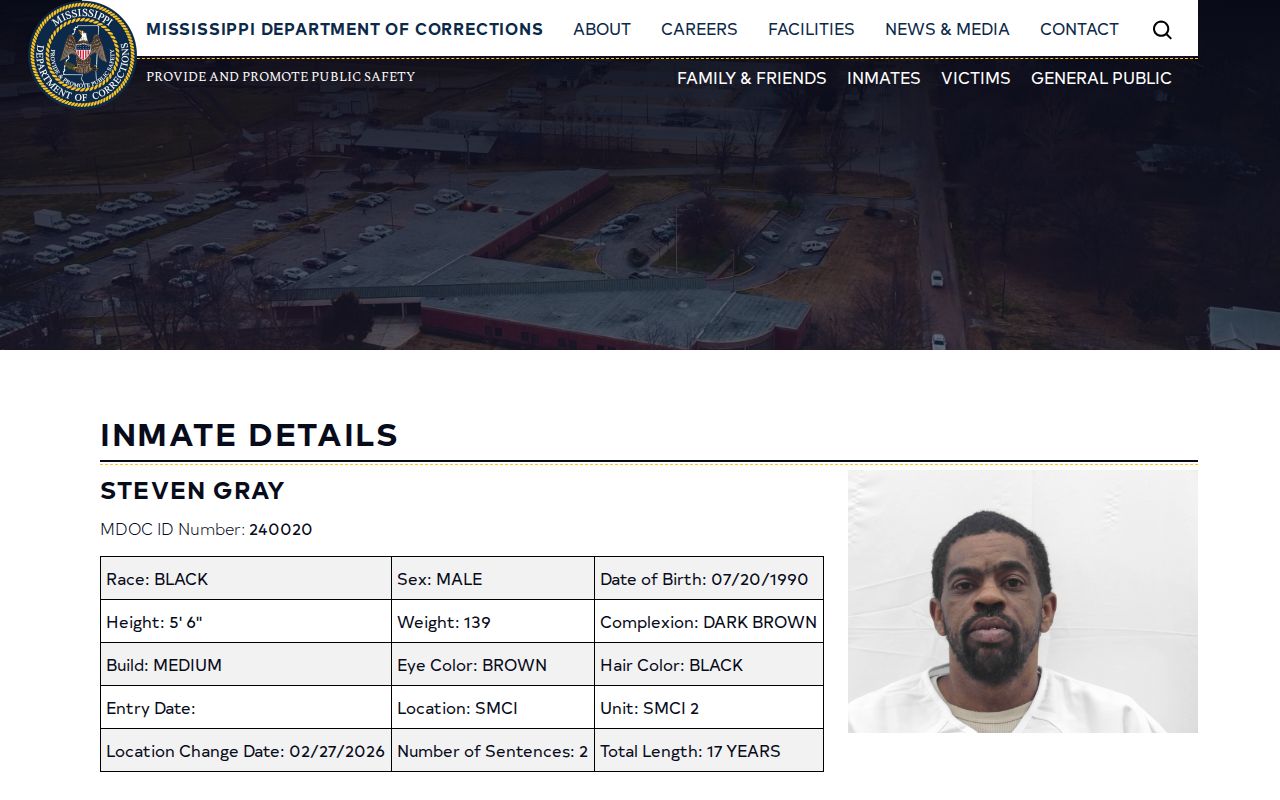
This image is a field example only. It does not depict a Monroe County release and should never be used as proof about the sample person.
Monroe County MDOC Release Fields
The MDOC offender search accepts either a name or an MDOC ID. The ID route is safer because names can collide. Open the individual page and compare identity, birth information, physical description, conviction county, offenses, sentence dates, location, and unit. The detail may show a state prison, regional facility, county jail, community status, or coded placement. Location must be interpreted with the legal custodian.
| MDOC field | Why it matters |
|---|---|
| MDOC ID | Provides the strongest public search key and belongs in every Records request. |
| Entry date | Shows when the MDOC record began, subject to sentence and jail-credit details. |
| Location and unit | Shows current placement or status, which may include a county unit. |
| Location-change date | Helps distinguish a new placement from an old status. |
| Sentence fields | Identify offense, county, length, and sentence date. |
| Tentative Release Date | Reports a forecast, not a confirmed past release. |
A past tentative date with a facility still shown requires follow-up. Do not call the person overdue or assume a data error. Detainers, recalculation, discipline, consecutive terms, restored or lost credits, and later court orders can affect the result. MDOC Records and the case manager hold the operational detail that the public page does not reveal.
Note: A county-jail location on an MDOC record can reflect MDOC legal custody, so the location name alone does not define the sentence system.
Monroe County Earned Release Time
Mississippi Code section 47-5-138 permits qualifying people sentenced after June 30, 1995, to earn 4.5 days for each 30 days served, capped at 15 percent, when MDOC finds the required conduct and performance compliance. Sections 47-5-138.1 and 47-5-139 add ERS rules, exclusions, and limits. This framework supports the common 85/15 description, but 85 percent is not a universal release formula.
The MDOC Types of Supervision explanation describes ERS and the state's 85/15 framework.

The official description provides context, while an individual timesheet remains necessary for a personal calculation.
Parole eligibility is governed separately by section 47-7-3 and related provisions. Section 47-7-3.2 applies added minimums to crimes on or after July 1, 2014, subject to its exact terms. The research identifies 25 percent or ten years, whichever is less, for covered nonviolent sentences; 50 percent or twenty years for covered violent crimes; and 60 percent or twenty-five years for armed robbery, drive-by shooting, and carjacking. Life, habitual, sex-offense, and trafficking categories are excluded from that subsection's scheme. Current codification and the precise offense must be checked.
No one percentage resolves every sentence. Offense date, statutory class, multiple sentences, concurrent or consecutive structure, jail credit, forfeited or restored time, detainers, court changes, parole action, and ERS eligibility all matter. A generic calculator cannot see those facts.
Why Monroe County Release Dates Change
The forecast starts with the controlling sentence and the credited start point. Eligible pre-sentence jail time can move that point when it is tied to the relevant cause and properly documented. Post-sentence county time under an MDOC commitment is incorporated differently. The MDOC timesheet is the authoritative personal computation, not a subtraction made from a sentence length shown online.
| Factor | Possible effect | Source to check |
|---|---|---|
| Eligible jail credit | May move the sentence-begin date | Timesheet, commitment papers, and court record |
| Earned-time loss or restoration | Can move a tentative date later or earlier | MDOC computation |
| Multiple sentences | Concurrent or consecutive structure changes the total | Sentencing orders and MDOC timesheet |
| Detainer or warrant | May prevent community release or cause transfer | Holding and receiving agencies |
| Court modification | May alter the sentence or custody authority | Certified court order |
| Parole or ERS processing | An eligibility or grant date may not be the exit date | Board, MDOC, and case manager |
A court may enter a release or time-served order before jail staff complete physical discharge. Both dates can be correct for different reasons. The order shows legal authority. The jail docket shows operational release time. Another hold, transport step, or processing need may explain a gap, but the record should establish the reason before it is stated.
Monroe County Tentative Versus Actual
MDOC's public field intentionally says Tentative Release Date. The agency also computes ERS and maximum dates, and those are not interchangeable. The MDOC Inmate Handbook describes the sentence-computation framework, while the agency FAQ says the case manager communicates the operational date and checks travel plans. It also says discharge processing can take 30 to 45 days and that an inmate must receive a discharge certificate before release.
A future tentative date answers, "When might release occur?" An actual discharge record answers, "Did release occur?" A location change to community status or an active parolee record can show that confinement ended while legal supervision continues. A discharge certificate provides stronger proof of completed release or discharge. These records should be read with the sentencing court file when the legal basis matters.
Parole adds another stage. The Mississippi State Parole Board can grant, deny, continue, or defer a matter. A grant can still require plan approval or processing. The Board notice, case manager information, MDOC location change, and later supervision record form a better chain than the eligibility date alone.
- Projected date
- An estimate based on present sentence and credit information.
- Tentative Release Date
- The exact public MDOC forecast label, not a confirmation.
- ERS
- A community phase of an MDOC sentence for an eligible person.
- Discharge certificate
- The MDOC document required before release under the agency's stated process.
Request Monroe County Release Computations
MDOC Records answers sentence-time, jail-credit, and eligibility questions. Use the person's name and MDOC ID. The office can be reached at P.O. Box 24388, Jackson, MS 39225; 601-933-2889; or MDOCRecordsDepartment@mdoc.state.ms.us. A focused request can ask for the actual release or discharge date and type, releasable discharge certificate, sentence-timesheet fields, and location or status history.
Public-record requests to MDOC must be in writing. The agency's GovQA route is separate from a call about a current computation. MDOC policy lists a page charge and may bill qualifying work beyond the first hour, but a requester should obtain the current estimate before chargeable work begins. Protected victim, staff, security, and supervision material may be withheld or redacted.
For county custody, ask the sheriff for the existing jail-docket or booking-release entry rather than a prediction the office does not publish. Include a name, identifier, and date range. Request the booking and release times, authority, and receiving agency if transferred. The sheriff's release record should then be reconciled with the court order.
Note: Ask each custodian for the record it created; the sheriff cannot certify MDOC computation, and MDOC cannot supply a county jail exit time.
Confirm Monroe County Actual Release
Confirmation depends on the custody path. A county detainee needs the sheriff's dated release entry and, when useful, the court order that authorized the event. An MDOC inmate needs the location or status change, parolee record when supervision begins, or discharge certificate when the sentence ends. A transfer should name the receiving agency and remain labeled as continued custody.
VINE can provide a timely release or transfer alert, but it is secondary to the originating file. The Monroe County VINE Inmate Check explains how to register for a matched record and preserve notice through Mississippi's Registration Link. Read the event wording carefully. Release, transfer, return, escape, and abscond are different events.
Record the agency, identifier, access date, exact status, and date shown. If sources conflict, ask the custodian to explain the field. A past forecast beside a current facility does not prove an overdue release. The official computation and later custody record control.