
Monroe County Parole and Probation
Parole and probation both permit a person to live in the community under rules, but they arise in different ways. The Mississippi State Parole Board may grant parole as a discretionary release from an MDOC sentence. A court imposes probation, often as part of a suspended sentence or judgment. MDOC's Division of Community Corrections supervises both statuses in the field. Earned Release Supervision, called ERS, is another community phase of an MDOC sentence. Intensive Supervision Program status, often called house arrest, is court ordered and managed by MDOC agents.
The legal source matters. A future parole eligibility date does not prove parole was granted. A Board grant also does not prove that physical release has occurred, since plan approval and processing may remain. By contrast, an active parolee record is strong proof that confinement ended and community supervision began. A probation order proves the court imposed that status, but the court order should be read with the reporting office record when current compliance or unit assignment matters.
| Status | Who authorizes it | Best verification source |
|---|---|---|
| Parole | Mississippi State Parole Board | MDOC parolee record, Board notice, and reporting office |
| Probation | Sentencing court | Court judgment or probation order and MDOC reporting office |
| ERS | MDOC under applicable law | MDOC status, sentence record, and assigned agent |
| ISP or house arrest | Court | Court order and MDOC supervision record |
- Discharge
- The formal end of a sentence or supervision obligation, as shown by the controlling record.
- Absconder
- A person alleged to have stopped reporting or complying while under supervision.
- Detainer
- A request or hold from another authority that can affect custody or release.
- Revocation
- An official action that can end community status and return a person to custody.
Verify Monroe County Post-Release Supervision
The MDOC parolee search accepts first name, last name, MDOC ID, city, and county. A Monroe County filter can narrow results, but it is not an identity match. The person may report in another county or through an interstate arrangement. Open the detail and compare the MDOC number. Name-only results can refer to someone else. The search establishes an MDOC community-supervision link, not the exact hour a Monroe County jail booking ended.
- Search by MDOC ID when it is known. Otherwise, use the exact name and narrow by city or Monroe County with care.
- Open the individual record. Compare the MDOC number, status, and location rather than relying on the results list.
- For parole, compare the record with the Board notice. For probation, obtain the sentencing court's judgment or probation order.
- Contact the Monroe Probation & Parole Office to confirm the right reporting unit or the correct way to reach the assigned agent.
- For a completed term, ask for the discharge record. A missing current search result alone does not prove that supervision ended.
The MDOC parolee interface shown in the captured record is the state route for checking a person under community supervision.
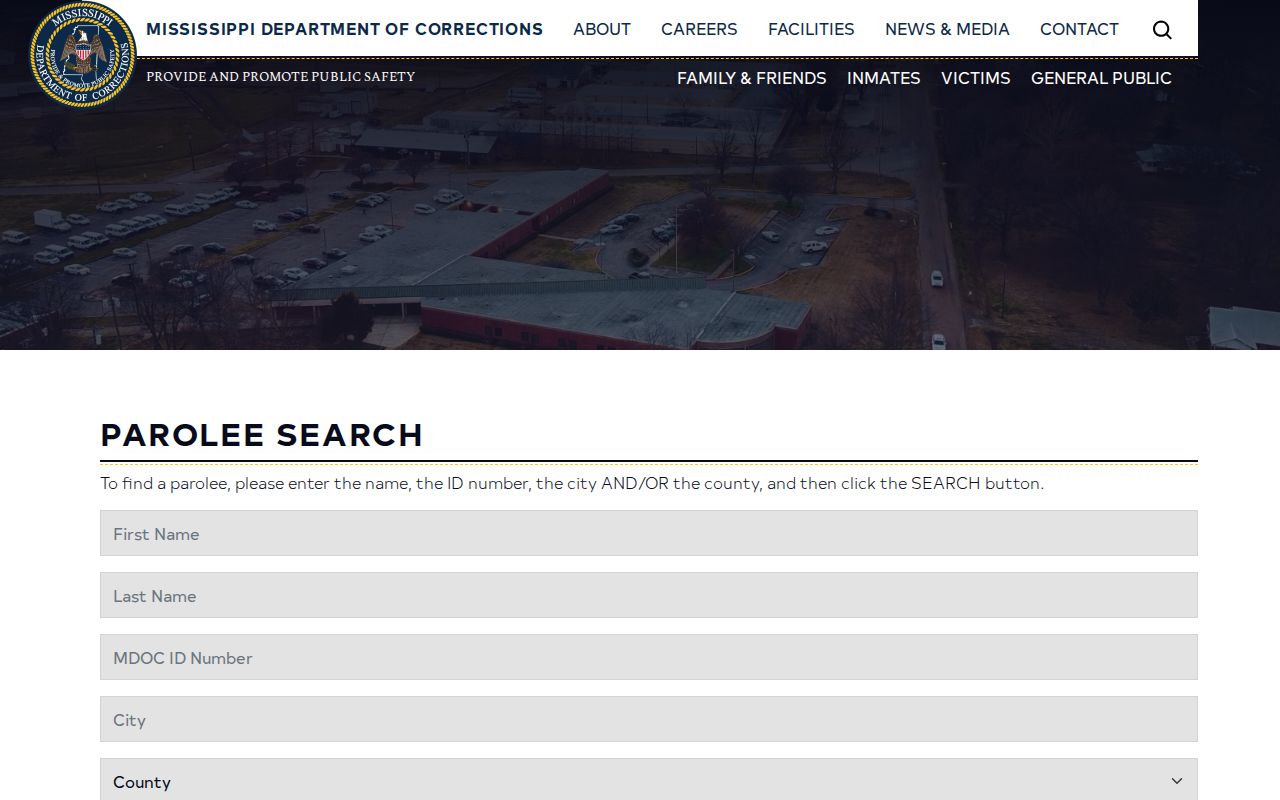
The county, city, and name fields help narrow the list, while the MDOC number remains the more dependable identity key.
Monroe County Supervision Office
Monroe County has a dedicated MDOC reporting office in Aberdeen. Its role is practical: the office can help identify the reporting unit and explain how a supervised person may communicate with an assigned agent. Public access has limits. MDOC policy protects parole and probation field-officer records, so agent notes, home information, reports, and the full case file should not be expected from a general request.
Monroe Probation & Parole Office209 E. Commerce St.
Aberdeen, MS 39730
Phone: 662-369-2779
Fax: 662-369-2964
The official Monroe office page identifies this location as MDOC's county Probation & Parole facility.
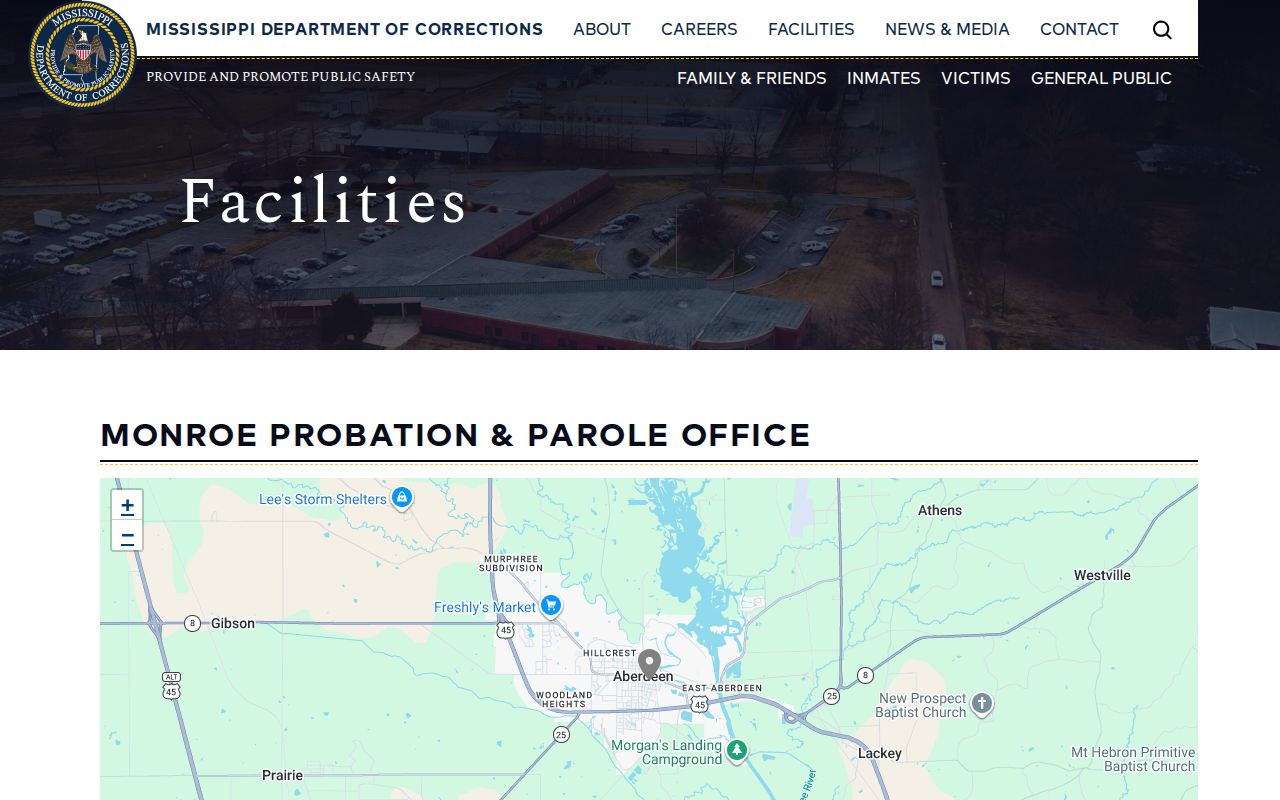
This office listing is the direct local source for address and phone details, not proof of any one person's status.
MDOC Records handles a different task. Questions about a sentence computation, discharge certificate, jail credit, or actual release date go to MDOC Records at P.O. Box 24388, Jackson, MS 39225, by phone at 601-933-2889, or by email at MDOCRecordsDepartment@mdoc.state.ms.us. Keep the MDOC number in the request so staff can distinguish people with similar names.
Monroe County Supervision Reporting
Mississippi Code section 47-7-36 permits reporting arrangements that reasonably accommodate schedules. It also permits simultaneous voice and video reporting portals where an officer uses them. That law does not create a general remote-reporting option for every person. The assigned agent controls the method, place, and schedule for an individual case.
A person should use the directions in the supervision paperwork and confirm any change with the agent or Aberdeen office. An online meeting should never be assumed merely because the statute allows the technology. The same caution applies to interstate supervision. Reporting responsibility can move across state lines under the Interstate Compact, so a Monroe County conviction does not always mean the Aberdeen office remains the active unit.
Note: Confirm each reporting method and schedule with the assigned agent; a statute that permits video contact does not promise it in a particular case.
Monroe County Supervision Changes
Conditions are the rules attached to community supervision. Their exact terms come from the court, Board, MDOC paperwork, and assigned agent. A violation is an alleged failure to follow those rules. It may lead to a warning, changed conditions, an arrest, a hearing, revocation, or return to custody, depending on the controlling process. Do not infer a violation from a stale page or a missed name match.
Absconder status means the agency alleges loss of contact during supervision. Monroe County has no verified public absconder or warrant list. Check the official MDOC status and VINE event wording, then contact the responsible agency. MS SAVIN/VINE includes events such as return to custody and abscond supervision, but an alert is a feed event rather than the full legal file. A warrant or revocation decision requires its own official source.
The distinction affects any status check. Release from confinement can be followed by parole, ERS, probation, or ISP. A later arrest can interrupt that community phase. The Monroe County released-inmate search and record path explains how the sheriff docket, court file, and MDOC record establish the underlying custody event.
Monroe County Parole Board Records
Eligible Mississippi cases are considered on a monthly cycle, with MDOC guidance describing a list prepared each month and review roughly ninety days before eligibility. There is no official public person-by-person hearing calendar. The State Parole Board administrative rules say hearings are closed, with Board staff setting appointments and notifying retained counsel. The lack of a public calendar is not proof that a case was skipped.
No official public decisions search was located. The rule provides decisions to the offender and in writing to qualifying victims or family, while other release requests are reviewed case by case. The Board also keeps a minute book of official actions and reasons. Possible actions include a grant, denial, continuance, later deferment, or revocation, but the exact notice controls. A grant still is not the same as physical release.
A narrow public-record request to the Board can ask for a releasable official action or minute-book entry, but confidential sources, safety facts, and reentry information may limit production. The offender's notice or qualifying victim notice is the direct route when available. After actual release, an MDOC parolee record can confirm community status. Before that point, a hearing event or favorable decision should remain labeled as a Board action, not as proof that confinement ended.
Mississippi State Parole Board239 N. Lamar St., Suite 501
Jackson, MS 39202
Phone: 601-576-3520
Email: MSStateParoleBoard@mdoc.state.ms.us
Parole eligibility under Mississippi Code section 47-7-3 depends on offense date and category. Sections 47-7-17 and 47-7-18 add procedures for covered cases. The current code and the person's official notice should be checked before any conclusion is drawn.
Monroe County Reentry After Release
The Monroe County Sheriff's official page describes addiction-focused programming and partnerships with churches and other groups aimed at improving success after release. WCBI also reported a local effort called the Restoration Initiative. These sources provide local context for post-release planning, but neither proves that a program is still operating, that space is open, or that a particular person qualifies.
Current details should be confirmed with the sheriff before relying on a program name. Supervision requirements remain separate. Participation in a local program does not replace an agent appointment, alter a court order, or prove discharge. It may form one part of an approved plan only when the responsible authority accepts it.
Monroe County Supervision Discharge
Supervision ends through the process tied to its source. A probation term follows the court judgment and any later order. Parole and ERS remain linked to the MDOC sentence and official status records. Full discharge usually means the sentence or supervision obligation has ended, but the precise certificate or agency record controls that meaning.
A person may disappear from the active parolee search because supervision ended, a record changed, or a search failed. Absence remains ambiguous. Ask MDOC Records for the final discharge date or certificate, and compare it with the sentencing court record. For parole, retain the Board notice and final MDOC status. Those records establish completion more reliably than an old eligibility date.
The court and corrections record may describe different parts of the same path. A court order sets probation terms or later modifies them. MDOC records the field supervision it administers. The Board controls parole decisions. When the sources appear to conflict, preserve each exact date and label, then ask the office that created the disputed field to explain it. One office should not be asked to rewrite another office's record.
Note: A future eligibility date predicts a possible stage, while an official discharge record confirms that the controlling obligation has ended.